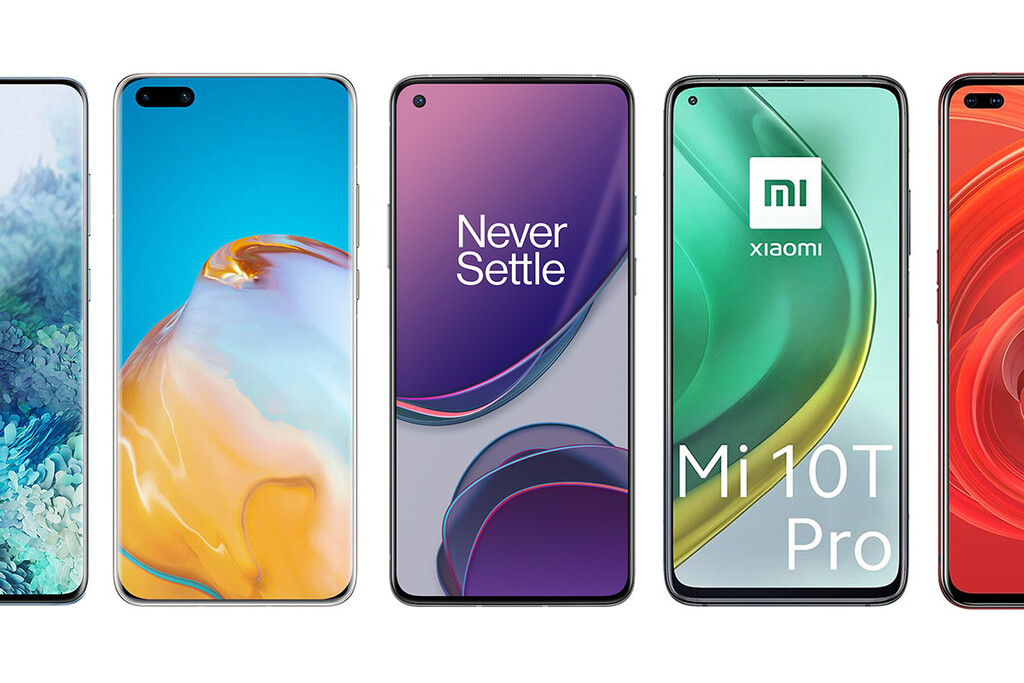
The OnePlus 8T is here: the second renewal of the year of its high-end that comes with a single version. There is no Pro version, but there are many of the features that we expect in a high-end this 2020. As is usual in these cases, we will take the opportunity to compare the OnePlus 8T with its direct competition in the high-end Android range.
We face it against other powerful 5G Android phones of the moment like the Xiaomi Mi 10T Pro, he Samsung Galaxy S20 + 5G, he Little F2 Pro, he Sony Xperia 5 II and the Realme X50 Pro, to see how it looks at least on paper as far as technical specifications are concerned.
Screen as expected
Considering that the OnePlus 8 Since the first half of the year it was launched with a screen at up to 90 Hz, it was inevitable that the OnePlus 8T would repeat the play or increase the refreshment even a little more. The 60 Hz “of all life” is rapidly dying out this 2020 in the high-end and the OnePlus 8T bets on 120 Hz, the same refresh rate present in the Samsung Galaxy S20 + and the Sony Xperia 5 II.
It would be the maximum figure if it were not for the fact that the Xiaomi Mi 10T Pro scores the goal, slightly, reaching 144 Hz. Other terminals in our comparison remain at 90 Hz such as the Realme X50 Pro and the Huawei P40 Pro, while the Poco F2 Pro is the only one that has standard 60 Hz refresh rate, despite increasing the touch response rate. Another aspect in which everyone agrees is to include an OLED panel and Full HD + in all cases except the Galaxy S20 +, which reaches up to QHD +.
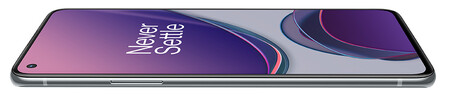
There are therefore no big surprises on the OnePlus 8T screen, which is basically how we would expect in a high-end mobile this 2020, including perforated front camera. This is still the preferred solution to the problem of where to include the front camera when the screen goes from edge to edge, although in our comparison there are still two terminals of the resistance: the Sony Xperia 5 II includes it in the upper frame and the Poco F2 Pro has it motorized.
The four lenses, do not miss
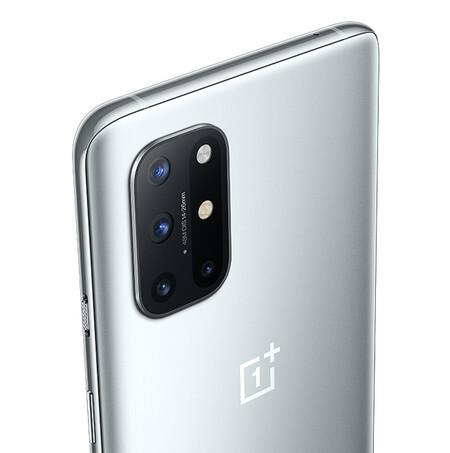
For better or for worse, it has been standardized that mobiles must have four-lens cameras, and that is exactly what we find in the high-end Android range. There are few exceptions, although there are: the Xiaomi Mi 10T Pro and the Sony Xperia 5 II have a triple camera.
The OnePlus 8 had three lenses and the OnePlus 8T has four: a 48-megapixel main sensor, a 16-megapixel ultra-wide, a 5-megapixel macro sensor, and a last 2-megapixel monochrome sensor. It’s a pretty standard bet where maybe you can miss a telephoto lens like the one present in many of the competing mobiles.

In front cameraAs we mentioned before, it is mounted in a hole in the screen in one corner and has a resolution of 16 megapixels. It is in line with the average, with competing mobiles with a lower resolution camera (such as the 8 MP of the Sony Xperia 5 II or the 10 MP of the Galaxy S20 +) and others with more and 32 megapixel double lenses, such as the Realme X50 Pro and the Huawei P40 Pro.
Buddy, where’s my wireless charging
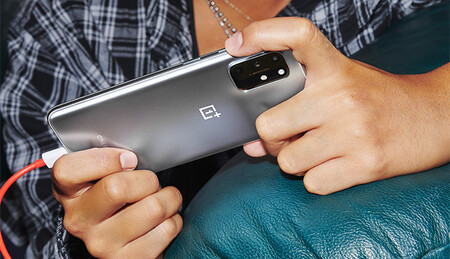
The OnePlus 8 Pro had 30W wireless charging and the OnePlus 8 was without it. The OnePlus 8T has no wireless charging, although the truth is that it is relatively difficult to find it also in the competition: from our list, only the Samsung Galaxy S20 + 5G and the Huawei P40 Pro have it.
There is no wireless charging, but there is very fast charging with cable. The fast charge of the OnePlus 8T reaches 65W, the same as the Realme X50 Pro and superior to the rest, which in most cases remains at 33W or 40W at most, in the case of the Huawei P40 Pro. Regarding the capacity of said battery, 4,500 mAh, it is in the line of the rest: not as much as the 5,000 mAh of Xiaomi, but more than the 4,000 mAh of Sony.
In power, we have practically unanimity in mounting the Snapdragon 865, with the only exception of those who mount the most powerful of their house: Huawei with its Kirin 990 and Samsung with its Exynos 990. In the RAM, the OnePlus 8T is presented in two versions with 8 and 12 GB of RAM, again usual.
Comparison chart
As always, we leave you with the complete comparison table including all the specifications of each model so you can see what each one has and what it does not have, according to your preferences.
|
OnePlus 8T |
Xiaomi Mi 10T Pro |
Realme X50 Pro |
Huawei P40 Pro |
Samsung Galaxy S20 + 5G |
Little F2 Pro |
Sony Xperia 5 II |
|
|---|---|---|---|---|---|---|---|
|
screen |
AMOLED 6.55"
FullHD + |
LCD 6.67 “ |
AMOLED 6.44 “ |
OLED 6.58 “ |
AMOLED 6.7 “ |
AMOLED 6.67 “ |
OLED 6.1"
FullHD + |
|
Dimensions and weight |
160.7 x 74.1 x 8.4 mm 188 g |
165.1 x 76.4 x 9.33 mm. |
159 x 74.2 x 8.9 mm |
158.2 x 72.6 x 8.95 mm |
161.9 x 73.7 x 7.8 mm |
163.3 x 75.4 x 8.9 mm |
158 x 68 x 8 mm 163 g |
|
Processor |
Snapdragon 865 |
Snapdragon 865 |
Snapdragon 865 |
Kirin 990 |
Exynos 990 |
Snapdragon 865 |
Snapdragon 865 |
|
RAM |
8/12 GB |
8 GB |
8/12 GB |
8 GB |
8/12 GB |
6/8 GB |
8 GB |
|
Storage |
128/256 GB |
128/256 GB |
128/256 GB |
256 GB |
128/512 GB |
128/256 GB |
128 GB |
|
Frontal camera |
16 MP f / 2.0 |
20 MP f / 2.2 |
32 MP f / 2.5 |
32 MP f / 2.2 |
10 MP |
20 MP |
8 MP f / 2.0 |
|
Rear camera |
48 MP f / 1.75 16 MP f / 2.2 UGA 5 MP f / 2.4 macro 2 MP monochrome |
108 MP f / 1.69 |
64 MP f / 1.8 |
50 MP f / 1.9 |
12 MP |
64 MP |
12 MP f / 1.7 12 MP f / 2.4 telephoto 12 MP f / 2.2 UGA |
|
Drums |
4,500 mAh Fast charge 65W |
5,000 mAh |
4,200 mAh |
4,200 mAh |
4,500 mAh |
4,700 mAh |
4,000 mAh Fast charge 21W |
|
Others |
5G Stereo speakers Fingerprint reader on the screen |
5G |
5G |
5G |
5G |
5G |
5G Stereo speakers Fingerprint reader on the side |
| Starting price | From 599 euros | From 599 euros | From 599 euros | From 899 euros | From 1,109 euros | From 529 euros | From 899 euros |
was originally published in
Xataka Android
by
Ivan Ramirez
.